
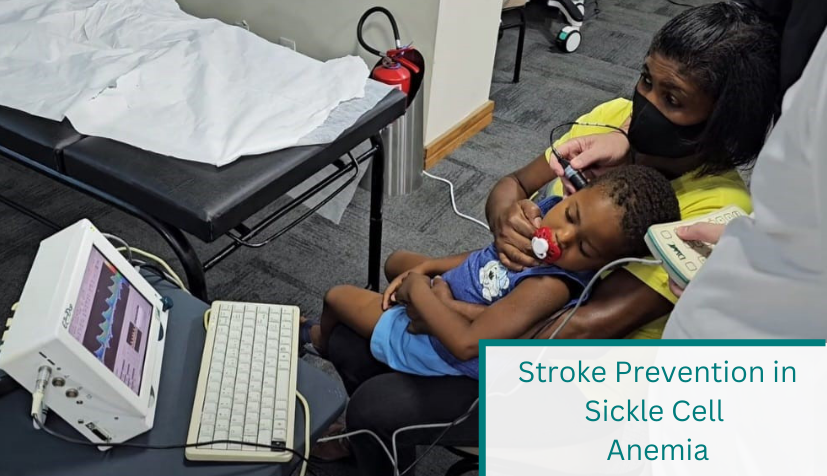
14 Jan 2026 Stroke Prevention in Sickle Cell Anemia
TCD-Guided Stroke Prevention in Sickle Cell Disease
Children with sickle cell anemia (SCA) face a high risk of ischemic stroke, particularly in regions where access to transfusion-based prevention is limited. In Nigeria—home to roughly half of all children born with SCA each year—standard U.S. protocols relying on regular blood transfusions are not feasible. The work led by DeBaun and colleagues outlines how transcranial Doppler (TCD) screening and hydroxyurea therapy were used to build the first sustainable, evidence-based stroke prevention program for children with SCA in Africa.
Clinical background
In high-income countries, annual TCD screening identifies children with elevated velocities who are at increased stroke risk. For those with velocities ≥200 cm/s, monthly blood transfusions for at least one year reduce incidence from approximately 10.7 events per 100 person-years to around 1 event per 100 person-years.
In Nigeria, this strategy cannot be implemented at scale due to limited resources. To address this gap, the team developed an alternative approach using fixed-dose hydroxyurea guided by TCD findings.
SPIN and SPRING trials
The effort began with the SPIN trial, a feasibility study evaluating moderate-dose hydroxyurea (20 mg/kg/day) for children with abnormal TCD velocities.
Following its success, the team initiated the SPRING trial, a double-blind, multicenter, randomized phase III study comparing:
- Low-dose hydroxyurea: 10 mg/kg/day
- Moderate-dose hydroxyurea: 20 mg/kg/day
The trial was stopped early after interim analysis showed no difference in stroke rates between the two dosing groups. Importantly, both doses significantly reduced stroke incidence compared to the expected rate in untreated children with abnormal velocities:
- 1.19 strokes / 100 person-years (low dose)
- 1.92 strokes / 100 person-years (moderate dose)
These data represent the first evidence-based primary prevention strategy for children with SCA in Africa.
Capacity building and research development
A core component of the program was long-term investment in local clinical and research expertise. Over six years, 23 Nigerian professionals—including physicians, nurses, pharmacists, coordinators, and a statistician—completed intensive training through the Vanderbilt Institute for Research Development and Ethics (VIRDE).
Additional achievements include:
- Six team members obtaining SOCRA accreditation
- Establishment of the first Nigerian SOCRA chapter
- Multiple physicians advancing to independent investigators through programs such as CRTI, VECD, Fogarty awards, and the TALENTS program
This training infrastructure enabled local investigators to lead major trials and sustain the clinical program beyond the initial studies.
State partnership and sustainability
To ensure long-term implementation, the team partnered with public health officials in Kano State. Key outcomes included:
- Establishment of the Kano Health Trust Fund (2019), allocating 6% of its budget to vulnerable groups, including SCA
- State-funded hydroxyurea procurement from a local pharmaceutical company (Bond Chemical, Ibadan)
- Independent laboratory verification of hydroxyurea quality through an FDA-registered facility
- Development of a low-cost electronic prescribing system using iPad and REDCap to track hydroxyurea distribution across clinical sites
This collaboration created a scalable structure capable of delivering preventive therapy regardless of a family’s ability to pay.
Scaling TCD screening
TCD screening was central to the program’s strategy. Through philanthropic support, 18 TCD systems were purchased for participating hospitals, with additional devices acquired later to expand coverage to tens of thousands of children.
As of the publication, the program achieved:
- 8,207 TCD assessments
- 640 children identified with abnormal velocities
- 99% of high-risk children initiated on hydroxyurea
These numbers represent one of the largest TCD-guided stroke-prevention initiatives in Africa.
Conclusion
The integration of TCD screening, randomized clinical trials, local capacity building, and governmental partnerships enabled the establishment of a reliable, evidence-based stroke prevention program for children with sickle cell anemia in Nigeria.
The SPIN and SPRING trials demonstrated that fixed-dose hydroxyurea is an effective alternative in settings where transfusion therapy is not feasible. The resulting infrastructure—spanning clinical care, research training, pharmaceutical collaboration, and digital systems—illustrates a scalable model for primary stroke prevention in low-resource environments.
DeBaun, M. R. (2022). Primary stroke prevention in children with sickle cell anemia living in Africa: The false choice between patient-oriented research and humanitarian service—Part II. Transactions of the American Clinical and Climatological Association, 132, 236–248.